How Banana Pudding Became Barbecue’s Iconic Dessert
Not as old of a tradition as you might think
Posted November 10, 2025
11-10 2025
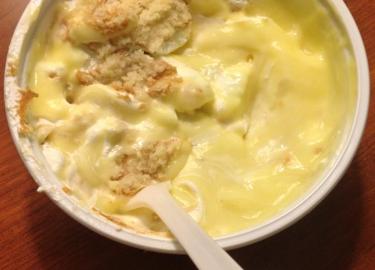
In 2015 I wrote an article for Serious Eats called, “How Banana Pudding Became a Southern Icon.” It dug deeply into the history of that classic Southern dessert and documented how it came to be so closely associated with the South.
I ended by nodding toward a yet-unsolved banana pudding mystery: “How come you can’t swing a dead cat in a Southern barbecue joint without hitting a bowl of banana pudding?” The question, I teased, “is more involved and complicated than you might think, and we’ll save it for a later installment.”
I never did get around to filing that later installment, in part because I didn’t really know the answer. I surmised that banana pudding may have been adopted by barbecue restaurateurs just before World War II, when so many of America’s great regional barbecue traditions were birthed. It turns out that was wrong.
I’ve gone back to the well now for another round of research, and it’s clear that banana pudding is the most iconic barbecue dessert today, found in just about every craft barbecue hot spot and modest mom-and-pop joint from Miami to Seattle. But that association with barbecue is a relatively recent development, something that happened within my own lifetime.
Banana Pudding Before Barbecue
Banana pudding is closely associated with the South today, but like pimento cheese and fried green tomatoes, it didn’t start out with a particular Southern identity. It originated as a novel fancy food in the second half of the 19th century, a time when new international trade networks were turning once-exotic ingredients like oranges and bananas into affordable household staples.
As the Central American banana trade boomed in the 1870s and 1880s, recipes for banana-based desserts began appearing in all sorts of cookbooks and newspaper columns, and they included various puddings that incorporated bananas. These early concoctions were modeled on the traditional English trifle, with a glass dish lined with chilled custard and filled with layers of sponge cake and sliced bananas then topped with more custard and either whipped cream or meringue.
Over time, bakers began substituting lady fingers for the sponge cake, and the modern form of banana pudding emerged in the 1920s when cooks began using a cheaper and more convenient base: vanilla wafers. In the 1940s, Nabisco began publishing its now-iconic banana pudding recipe on boxes of its Vanilla Wafers. (The Nilla brand wasn’t adopted until the 1960s.) When home cooks opted for the convenience of using Cool Whip instead of whipped cream and instant pudding mix instead of custard, the industrial transformation of banana pudding was complete.
In the post-War era, banana pudding was a staple on family restaurant buffets and at big gatherings like church picnics, funerals, and football tailgates. One place you were unlikely to find it was at a barbecue restaurant.
Barbecue Discovers Banana Pudding
The earliest example I could find of banana pudding being served in a barbecue restaurant is actually pretty old, going all the way back to 1927. That’s when Smitty’s Barbecue Lunch in Macon, Georgia, started advertising banana pudding alongside its “Real Pit Barbecue” in the local newspaper.

That seems a random outlier, though. This and other ads for Smitty’s suggest it was more of a lunchroom with a barbecue pit than a pure barbecue joint, and banana pudding was served as part of daily lunch specials with Salisbury steak, baked meat loaf, or veal steak as the main course.
After World War II, barbecue crossed over from being something sold primarily at roadside stands to become more of a mainstream restaurant item served alongside steaks, chops, and roasted chicken. Banana pudding pops up next to barbecue in a few restaurants here and there, such as the Yarborough Grill in Huntsville, Alabama, which in 1950 advertised a home-cooked dinner featuring roast chicken with dressing or “pit barbecue” along with two vegetables, coffee or tea, and banana pudding for 55c.
In the adoption of banana pudding, as with many other now-iconic barbecue items, the Piedmont region of North Carolina seems to have led the way. Piedmont joints like Stamey’s, for instance, had been the first to add hushpuppies to their menus, a fried cornmeal treat that the pitmasters picked up from local fish camps and seafood restaurants. Other barbecue restaurants in the same area were the first to embrace banana pudding.
In 1962, a trio of Greek-American restaurateurs, Andy and Nick Carros and Tom Gallos, founded Mr. Barbecue in Winston-Salem, North Carolina. Nine year later, in 1971, they began running ads featuring “Mr. Pope, our chef,” who advised, “top off the best Bar-B-Que in town with our home-made BANANA PUDDING.”

In 1979, the Winston-Salem Sentinel published a feature on Hill’s Lexington Barbecue, and for dessert it recommended the homemade pies — apple, chocolate, coconut, pecan, ice-box lemon — and noted, “Banana pudding is served Tuesday through Friday.”
Mr. Barbecue, I should note, is still in business today, and it’s still serving homemade banana pudding. Hill’s Lexington Barbecue closed in January 2020, but I ate there several times before it did and remember its banana pudding fondly. It was made with real custard and meringue, toasted golden brown in the oven, and served warm in white ceramic bowls. Unfortunately, I don’t have a picture of Hill’s banana pudding, but I do have one of its splendid sign.

By the 1980s, banana pudding had become a fixture in barbecue restaurants across the state. In his book, North Carolina Barbecue Flavored by Time (1996), Bob Garner stated definitively, “Banana pudding is the most widely served dessert in North Carolina barbecue restaurants.”
The sweet treat was soon embraced across the border in South Carolina, too, where it was a natural addition to the all-you-can-eat buffets that were the hallmark of Palmetto State joints. In 1994, William J. Hamilton, III, wrote a column for the Charleston Post & Courier celebrating, “the barbecue restaurants that stand on the fringes of the small towns” along I-26, which “open on Thursday and close after Sunday dinner. Rice is always first on the buffet line and banana pudding always at the end.”
The adoption was slower in other parts of the country, including in Texas. I was able to turn up a few early appearances of banana pudding on barbecue menus and in newspaper ads in the 1980s, including at Circle-J Bar-B-Q in Fort Worth in 1986, which listed “homemade banana pudding” after the bologna and hot links. The dessert appears only a single time in a 1987 round-up of local barbecue restaurants in the Fort Worth Star-Telegram. “Extras like cobbler and banana pudding” could be found at Cousin’s Pit Barbecue, which is described as “the best of the clean, family-type suburban barbecue restaurants.”
Indeed, Texas barbecue purists seemed a little suspicious of this new-fangled interloper. In 1988 Bud Kennedy of the Star-Telegram reviewed Larry’s Crossing, which he described as “a modern barbecue-and-beer hangout” in west Fort Worth. “At most barbecue restaurants,” he noted, “if you want dessert you get a mint on the way out. But Larry’s bakes up homemade chocolate cakes and serves homemade banana pudding thick with vanilla wafers.”
From Novelty to Barbecue Icon . . . And Beyond
It wasn’t until the first decade of the 21st century that restaurants fully embraced banana pudding and made it America’s ubiquitous barbecue dessert. The first edition of Rob Walsh’s Legends of Texas Barbecue Cook Book (2002) makes no mention of banana pudding. The revised edition in 2016, however, highlights it at several places, including at Pecan Lodge in Dallas, which was founded in 2010 by Justin and Diane Fourton and serves banana pudding inspired by Diane’s aunt’s recipe.
Pecan Lodge is included in a section entitled, “Stainless Steel and Glass,” which discusses the “back-to-roots movement” in Texas barbecue led by Aaron Franklin and other “young pitmasters . . . going back to the basics in hip, new barbecue joints.” My hypothesis is that the goal of getting back to the roots is why banana pudding came to be so popular in American barbecue restaurants.
In the early 21st century, a new generation of pitmasters entered the business and looked to the past for inspiration. They were passionate about authenticity and embraced older barbecue methods—cooking on wood instead of gas, taking it low and slow with no shortcuts. In the process, I think, they swept in lots of things that had old-school Southern associations if not necessarily a long barbecue lineage. When it comes to dessert, what could be more authentically down-home than something your aunt or grandma made from the recipe on the Nilla Wafer box?
Now that banana pudding is the (new) traditional barbecue side, restaurants are starting to get creative and putting their own signature twists on it.
It was at the recently-shuttered Buxton Hall BBQ in Asheville that I first encountered banana pudding pie, which pastry chef Ashley Capps made with a crust of crushed homemade vanilla wafers, rich custard layered with sliced bananas, and a crown of meringue toasted with a hand torch. (Yes, Buxton Hall was the kind of barbecue place that had pastry chef.) Capps told Bryan Roof of America’s Test Kitchen that she was inspired by her mother’s meringue-topped banana pudding, and she transformed it into a pie as “a combination of technique and nostalgia” that blended her “inner child and Southern roots.”

Back in his food truck days, Aaron Franklin served warm banana pudding as a dessert, but it’s not on the menu at his brick-and-mortar restaurant in Austin. Instead, he serves handmade pies from local bakery Cake and Spoon, including Bourbon Banana Pie, which is described as “a riff on the classic banana pudding served at BBQ joints across the land.”
We’ve come a long way from grabbing a mint on the way out the door.

About the Author
Robert F. Moss
Robert F. Moss is the Contributing Barbecue Editor for Southern Living magazine and the author of six books on food, drink, and travel, including The Lost Southern Chefs, Barbecue: The History of an American Institution, Southern Spirits: 400 Years of Drinking in the American South, and Barbecue Lovers: The Carolinas. He lives in Charleston, South Carolina.