On Coleslaw and Barbecue
Digging into a historic but controversial combo
Posted January 9, 2026
01-09 2026
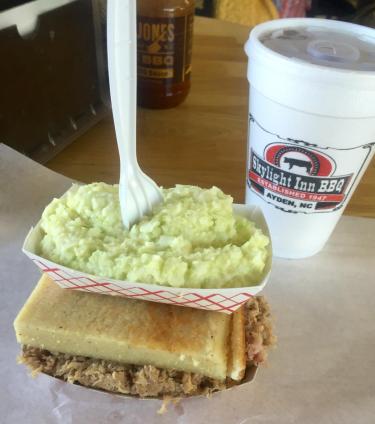
In my writing, I generally try to steer clear of divisive topics, but in these days of heated rhetoric and polarization that can sometimes be hard to do. Every now and then, you have to weigh in on a topic about which you have strong feelings and let the chips fall where they may.
I am talking, of course, about coleslaw and its relationship to barbecue.
For such a simple preparation, everything about coleslaw is surprisingly complicated. For starters, does it even belong within a mile of a barbecue plate? Some eaters are surprisingly pugnacious on the question. Over the years I’ve heard it labeled everything from boring to “an abomination” and “the devil’s vomit.” Perhaps those folks have a deep-seated aversion to mayonnaise or to cabbage’s crisp crunch, but, boy, does slaw rub them the wrong way.
Others, of course, insist coleslaw is an essential barbecue side and the ideal topping for a sandwich. In 1984, Craig Claiborne raved about North Carolina barbecue in the New York Times, calling its chopped pork “by far my favorite kind of barbecue. . . . In a bun with a little cole slaw, it’s as close to perfection as barbecue can be.” Pat Martin told me that when he opened the first Martin’s Bar-B-Que Joint in Nolensville, Tennessee, he tried to charge customers fifty cents extra for a barbecue sandwich without slaw on it. (Cooler heads talked him out of it.)
I’ll let Wilber Shirley of Wilber’s Barbecue in Goldsboro have the final word on the question. Mr. Shirley passed away in 2021 at the age of 90, but he was interviewed by William McKinney, Dale Reed’s and John Shelton Reed’s collaborator for Holy Smoke: The Big Book of North Carolina Barbecue (2008). “You’ve got to have coleslaw,” Shirley told McKinney. “I won’t even sell somebody a barbecue unless they get coleslaw. If they want a barbecue and they don’t want coleslaw, there’s something wrong with that person.”
You slaw haters can stop reading now.
A Dish Best Served Cold
Next question: what should we call this essential barbecue companion? Is it “coleslaw” or just “slaw”?
Some say that asking for “slaw” with your order sounds coarse and unrefined, to which I reply, “You realize you’re in a barbecue joint, right?” Others, like the author of this post on Reddit, get downright pedantic, arguing that coleslaw is derived from the Dutch kool sla, or “cabbage salad,” so someone asking for “slaw” is really asking for salad.
“When I ask what sort of salad,” the Redditor writes, “they get confused. Can’t they just say Coleslaw or at least just ‘Cole’?”
I am assuming this person does not have a lot of friends. I will, though, keep the point in mind if I ever visit a barbecue joint operated by an 18th century Dutchman, lest my sandwich comes out topped with lettuce, tomato, and cucumbers.
Yes, coleslaw did indeed originate from the Dutch koolsla, with kool meaning cabbage and sla a reduced form of salade, but it crossed over into American English as early as 1794. Curiously, it did so not as “cole slaw” but as “cold slaw,” and “cold” remained the most common spelling until the 20th century.
As far as I am concerned, you can call it “slaw” if you like, or you can call it “coleslaw.” You can even call it “cold slaw,” if you are of a historical bent. It’s slaw the same to me.
Mixing It Up
Okay, but what do you dress the cabbage with? That’s where the real divergence begins. Vinegar slaw and mayonnaise-based slaw (sometimes called “white slaw”) are the two most common variants, though mayo-based recipes generally include a dose of vinegar, too. Both varieties are sometimes given a yellow mustard tinge.
Barbecue cognoscenti will have heard about “hot slaw,” that bright yellow, pepper-laced variant found primarily in a fifty mile radius of the convergence of the Tennessee, Alabama, and Georgia state lines. Hot slaw, unfortunately, is a rather involved topic, and we’ll have to save it for another day.
There’s also Piedmont North Carolina-style red slaw, a.k.a. “BBQ slaw.” I can’t describe it any better than Bob Garner did in his book North Carolina Barbecue: Flavored by Time (1996), so I’ll just quote him:
Western slaw is almost always red, and it has a totally different taste and texture than its eastern cousin. Whereas eastern slaw ranges in texture from shredded to nearly pulverized, Lexington-style slaw is almost always chopped into crunchy bits about the size of BBs. It’s basically seasoned with barbecue sauce instead of either mustard or mayonnaise, so it’s pepper-hot and vinegar-tangy, and it’s also fairly sweet, since more sugar is added than normally goes into the barbecue dip.
Garner, I should note, frowns upon the “fence-straddling places” in central North Carolina that serve eastern-style white slaw with Piedmont-style barbecue, calling that “clear evidence of a sort of barbecue split personality.”

As with mustard sauce and vinegar sauce in South Carolina, the once-distinct regional slaw lines are starting to blur. In 2018, Cecil Conrad, the owner of The Bar-B-Q Center in Lexington, admitted to Our State magazine, “We’ve snuck white slaw on the menu.” But, he added, “it’s buried near the bottom.”
A Historic Icon
Many of the barbecue side dishes that we consider classics today are actually relatively new additions to menus, like hushpuppies, macaroni and cheese, and banana pudding, which I wrote about in a Cue Sheet dispatch back in November. Slaw, however, has been served alongside barbecue for a long time—the OG barbecue side, if you will.
The earliest example I’ve found of slaw being served at a barbecue is from 1880, and it’s a doozy. In August of that year, a delegation from the Board of Trade and Transportation of Cincinnati made an excursion South to establish “closer and more intimate social and commercial connections with Georgia” (read: drum up new business.) They were invited by a committee of Augusta businessmen to attend a “genuine Southern barbecue” on the banks of the Augusta Canal.
The menu was printed in the Augusta Chronicle, and it merges the typical outdoor barbecue offering with the format of a formal banquet. Included among the “relishes” are potato salad, radishes, olives, pickles, celery, and “cold slaw.”

Boy what I wouldn’t give for an invitation to that feast. I am intrigued by the “barbecued shad” in the opening fish course, and I‘ll note that the barbecued meats include mutton, lamb, and kid (i.e. goat) alongside pig and chicken. Most curious is the “Entrées” course, which reads, “Hash — Turtle, Pig, Lamb, Mutton, Giblets.” I’m not sure whether that’s a single batch of hash made with all those ingredients or separate hashes made from each of them, but it’s the only time I recall seeing turtle make its way into the hash pot.
In the years that followed, “cold slaw” (and, eventually, slaw and coleslaw) was regularly mentioned in descriptions of barbecues of all types. In 1890, for instance, the Chattanooga Daily Times, reported the menu at the annual barbecue of the Retail Butcher’s Association “consisted of barbecued beef, lamb, pork, mutton, and veal, light bread, tomatoes, cold slaw, pickles, salad, onions and olives.” In July 1900, the community barbecue in Swift Creek Township near Raleigh featured a pig cooked perfectly brown and crisp along with “plenty of ‘fixings’ . . .The most delicious cold slaw, made by the women of Swift Creek, and sliced tomatoes fixed up to the king’s taste.”
By 1915, slaw was firmly established as a Southern barbecue staple. In May of that year, the Lakeland Evening Telegram reported on the preparations for the “Big Barbecue” at the annual Florida Citrus Exchange meeting in Orlando. It was big indeed, with 1,800 pounds of beef and 700 pounds of pork along with 1,500 loaves of bread and enough pickles and “cold slaw” to serve 5,000 people.

The event was staged by the Orlando Board of Trade, and G.R. Ramsey, the city engineer, was appointed chairman of the “cold slaw and pickle committee.” The newspaper reported that when the leaders of the Board of Trade reviewed the plans, “all agreed that slaw, ‘cold slaw,’ put the fine touch on the menu. When one member objected to slaw he was almost ‘slawed’ out of the meeting. Everybody wanted slaw.”
Everybody has been wanting slaw with their barbecue ever since. All the right-minded people, at least.
This dispatch was originally published in the Robert F. Moss Newsletter on Substack. Subscribe today for free and have my latest writing delivered straight to your inbox.

About the Author
Robert F. Moss
Robert F. Moss is the Contributing Barbecue Editor for Southern Living magazine and the author of six books on food, drink, and travel, including The Lost Southern Chefs, Barbecue: The History of an American Institution, Southern Spirits: 400 Years of Drinking in the American South, and Barbecue Lovers: The Carolinas. He lives in Charleston, South Carolina.